Showing posts with label Vanguard. Show all posts

Monday, January 30, 2023

Improve Long-term After-tax Return on 3-fund Portfolio using Asset Location

Summary

  1. For most individual investors, a simple 3-fund portfolio consisting of U. S. Stock Index, International Stock Index and Bond Index is the best way to invest in the market.

  2. In the accumulation (saving for retirement) phase, Asset Location (taxable, tax-free, tax-deferred) i.e. where you place your investments, is as important as Asset Allocation for maximizing after-tax return.

  3. Rebalancing your portfolio once a year is a good practice. It enables you to buy low and sell high automatically.

The Kiplinger article Using Asset Location to Defuse a Retirement Tax Bomb explains the strategy of asset location and why it is crucial to lowering tax bills in retirement.


As the article warns, implementing the optimal asset location strategy can be tricky if your portfolio consists of actively managed funds or ETFs that blend multiple asset classes. However, the implementation is greatly simplified if your portfolio consists of only 3 passively managed asset class pure index funds or ETFs.


In order to use the guidelines in this article, you should meet the following prerequisites.


  1. Asset Allocation: You have determined your suggested asset mix using the Vanguard Investor Questionnaire or using some other tool of your choice.

  2. Index Funds or ETFs only: Your portfolio consists of only 3 broad-based index funds or ETFs investing in total U.S. stocks, international stocks and bonds respectively.

In order to maximize your long-term after-tax returns (especially after retirement during the withdrawal phase), use the following approach to determine the asset location i.e. taxable, Roth IRA and tax-deferred accounts, for your stock and bond funds or ETFs:

  1. First, place total bond index fund in Traditional IRA and 401(k) accounts. Note that taxes on current income from bond investments in these accounts would be deferred until withdrawal. Also, capital gains would be taxed as ordinary income when withdrawn from these accounts during retirement. Maximizing bond allocation in these accounts will result in lower total income and therefore, lower taxes.

  2. Next, place any remaining total bond index fund in the Roth account. Income from bond investments in the Roth account will be sheltered.

  3. Next, place total international stock index fund in the taxable account. This order would work for most investors. It follows the recommendation by Bogleheads and Vanguard and is based on the set of assumptions related to US/International stock allocation, tax withholding rate, investor's marginal tax rate and qualified dividend proportion of the fund. Placing international stocks in the taxable account enables you to take advantage of foreign tax credit, which is not available in tax-advantaged accounts. Please refer to the above links to determine if it makes sense in your case.

  4. Finally, place total US stock index fund in the taxable account and in any remaining space in the Roth account. Place the remaining stock investments in any remaining space in the Traditional IRA and 401(k) accounts. Taxable accounts provide favorable capital gains treatment during the withdrawal phase and Roth accounts provide tax-free growth for stock investments.

The following screenshot illustrates the above calculations using a hypothetical portfolio of $1 million consisting of taxable, Roth IRA and 401(k). It assumes target stocks and bonds allocation of 70/30 i.e. 70% stocks and 30% bonds and target international stocks allocation of 20% of total stocks.


3-fund Portfolio using Asset Location strategy

If you need to make changes to your portfolio allocation and location, you can use Vanguard’s Portfolio Tester tool to test and rebalance your portfolio.

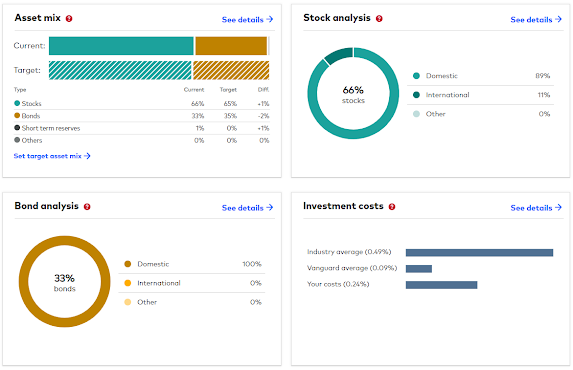
The following example shows the Portfolio Watch for the simple 3-fund portfolio in a single account that has the current allocation of 75/25 (stocks/bonds) with 10% of stocks in international stocks. 


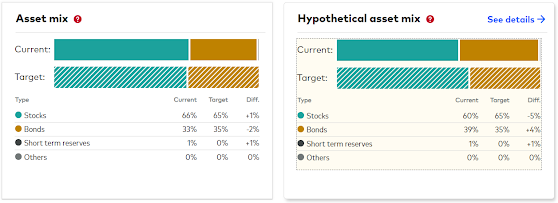
Let us suppose that our target allocation is 70/30 with 20% of stock allocation in international stocks. You can use the Portfolio Tester tool to make hypothetical changes to bring the portfolio to the desired target. Although this portfolio consists of a single account, the tool can also be used for testing changes across multiple accounts (taxable, Roth and tax-deferred).


Click "Analyze" to see the current and hypothetical portfolios side by side.


Click "See Details" next to Hypothetical Asset Mix to see the detailed analysis including risk and return for both portfolios, using past 97 years' data (1926-2022).


Note, however, that your actual rebalancing decisions will depend on many factors, including, your capital gains tax bracket, your tax filing status (single, married filing jointly, etc.) and the amount of your potential taxable capital gains for the year.

To be sure, selling an appreciated fund or ETF may trigger a tax bill unless you are careful. Read the following article to learn about tax-efficient rebalancing strategies: 7 Rebalancing Strategies That Are Tax-Efficient, Too!

Related:


Using Vanguard Investor Questionnaire to determine your asset allocation

Using Vanguard’s Portfolio Watch and Portfolio Tester for Rebalancing

What is the Capital Gains Tax and How is it Calculated? | Kiplinger

7 Rebalancing Strategies That Are Tax-Efficient, Too!

Tax-efficient fund placement (Bogleheads)

Asset location can lead to lower taxes. Here's how to get more value.


Disclaimer: This article is not intended to be investment advice. Consult a duly licensed professional for investment advice. The contents of this article are for educational purposes only and do not constitute financial, accounting, tax, or legal advice. Past performance is no guarantee of future results.


Tuesday, September 6, 2022

Using Vanguard’s Portfolio Watch and Portfolio Tester for Rebalancing

How you allocate your money among stocks, bonds, and short-term reserves may be the most important factor in determining the long-term return and volatility of your portfolio. Once you have determined your asset allocation, rebalancing your portfolio once a year is a good practice. You can pick a date (such as your birthday or anniversary) to rebalance your portfolio.


If you have one or more accounts at Vanguard, they offer two great tools for investors - Portfolio Watch and Portfolio Tester. Portfolio Watch helps you analyze your portfolio and Portfolio Tester enables you to test portfolio changes before submitting actual orders. These tools can help you to determine and set your target allocation, monitor any deviations from the target and help you with required rebalancing, if necessary.


You will find the Portfolio Watch tool as the last tab on the Overview page.


Portfolio Watch provides powerful analysis that helps you understand your assets, how your asset mix impacts your potential for growth and your portfolio risk, and how your costs compare with the industry averages. The Portfolio Watch home page provides a high-level analysis of your assets while each section allows you to see a more detailed analysis.


Portfolio Tester enables you to do “what-if” analysis of your planned changes before submitting actual buy, sell or exchange orders. This tool is handy when you want to rebalance your portfolio or when you are planning to add new money to your account or to sell part of your investments for withdrawal. You can use the Portfolio Tester tool to enter hypothetical orders (buy and/or sell) and view their effect on your asset allocation.


Although the portfolio watch tool is powerful and useful, some of the alerts generated by the tool should be taken with a grain of salt. Take the following portfolio alert, for example:


I think 30% to 50% allocation to foreign stocks is too high. I personally use 20% of the equity portion of the portfolio as my target allocation for international stocks. You may be using a different rule based on your needs and preferences. So, while the analysis is useful, use your own judgment and experience when reviewing the information, charts and especially the alerts presented by the tool. I primarily use this tool to view and monitor asset allocation. Related Post: Rethinking Global Exposure: How Much "International" Is Already in Your U.S. Stocks?


By default, Portfolio Watch includes all assets available for analysis. You can create custom groups to analyze specific assets or accounts.


The tool works best if you have all your investment accounts at Vanguard. However, outside assets are included if you have linked non-Vanguard accounts to your Vanguard account. You can also manually add outside assets for analysis. Manually added funds and stocks with ticker symbols are classified automatically by the tool. Some of the manually added assets for which data is not available may appear as an "Other" asset type. However, you can manually classify them as a "Stock", "Bond", or "Short-term reserve".


You can click the Portfolio Tester link on the top of Portfolio Watch page to initiate the tool.


On the Portfolio Tester tool, you have an option to enter one or more new holding(s) you are planning to buy or make changes to your existing holdings. Use a "-" sign for sales. For example, if you are planning to exchange a fund or ETF worth $10,000 to another fund or ETF, enter -10000 as the amount on an existing line for the fund or ETF you are planning to sell, under the appropriate account in which the fund is held and enter 10000 (without a sign) on the line for the fund or ETF you are planning to buy. For new purchases, simply enter an amount without a sign either on an existing line (if you already hold the fund) or add a new line.

The following screenshots illustrate the scenario where the investor plans to move $10,000 from the Total Stock Market Index Fund to the Total International Stock Index Fund. Note the "-" sign in "-10000" for the first fund.


Clicking the Analyze button presents the comparative analysis of your current and hypothetical portfolio (after planned changes) with an option to drill into each section for details.


Click "See Details" next to Hypothetical Asset Mix to see the detailed analysis including risk and return for both portfolios, using past 97 years' data (1926-2022).


Note that selling an appreciated fund may trigger a tax bill unless you are careful. Start with tax-sheltered accounts - 401(k) and IRA - when rebalancing. See the following article for more tax-efficient rebalancing strategies: 7 Rebalancing Strategies That Are Tax-Efficient, Too!


If you use the 3-fund portfolio, you can use these two tools to manage both portfolio allocation and portfolio location, to improve your long-term after-tax return.

In summary, Portfolio Watch and Portfolio Tester tools, available to Vanguard customers at no cost, are two great tools that can help investors with portfolio analysis and rebalancing. I suggest that you give them a try.


Related:


Using Vanguard Investor Questionnaire to determine your asset allocation


Improve Long-term After-tax Return on 3-fund Portfolio using Asset Location


Asset Allocation, Dollar Cost Averaging and Rebalancing - The Ultimate “Antifragile” Investment Strategy?


The Stock Market has (fill in the blank). What should I do now?


Disclaimer: This article is not intended to be investment advice. Consult a duly licensed professional for investment advice. The contents of this article are for educational purposes only and do not constitute financial, accounting, tax, or legal advice. Past performance is no guarantee of future results.


Saturday, August 14, 2021

Using Vanguard Investor Questionnaire to determine your asset allocation


As explained in the introduction to the Vanguard Investor Questionnaire: How you allocate your money among stocks, bonds, and short-term reserves may be the most important factor in determining the long-term return and volatility of your portfolio.

The Investor Questionnaire makes asset allocation suggestions based on your responses about your investment objectives, investing experience, time horizon, risk tolerance, and financial situation.


The following table contains sample responses for 4 different career and life phases. The second table shows allocation percentages suggested by the tool based on those responses.


#

Question

20s-40s Working

50s Working

Nearing Retirement

In retirement

1

I plan to begin taking money from my investments in . . .

More than 15 years

11-15 years

3-5 years

Less than 1 year

2

As I withdraw money from these investments, I plan to spend it over a period of . . .

More than 15 years

More than 15 years

More than 15 years

More than 15 years

3

When making a long-term investment, I plan to keep the money invested for . . .

More than 8 years

More than 8 years

More than 8 years

More than 8 years

4

From September 2008 through November 2008, stocks lost over 31%. If I owned a stock investment that lost about 31% in three months, I would . . .

Hold on to the investment and sell nothing

Hold on to the investment and sell nothing

Hold on to the investment and sell nothing

Hold on to the investment and sell nothing

5

Generally, I prefer an investment with little or no ups and downs in value, and I am willing to accept the lower returns these investments may make.

I strongly disagree

I strongly disagree

I strongly disagree

I strongly disagree

6

When the market goes down, I tend to sell some of my riskier investments and put money in safer investments.

I strongly disagree

I strongly disagree

I strongly disagree

I strongly disagree

7

Based only on a brief conversation with a friend, coworker, or relative, I would invest in a mutual fund.

I strongly disagree

I strongly disagree

I strongly disagree

I strongly disagree

8

From September 2008 through October 2008, bonds lost nearly 4%. If I owned a bond investment that lost almost 4% in two months, I would . . .

Hold on to the investment and sell nothing

Hold on to the investment and sell nothing

Hold on to the investment and sell nothing

Hold on to the investment and sell nothing

9

The chart below shows the highest one-year loss and the highest one-year gain on three different hypothetical investments of $10,000. Given the potential gain or loss in any one year, I would invest my money in . . .

Investment B (gain $1,921; loss -$1,020)

Investment B (gain $1,921; loss -$1,020)

Investment B (gain $1,921; loss -$1,020)

Investment B (gain $1,921; loss -$1,020)

10

My current and future income sources (such as salary, Social Security, pension) are . . .

Very stable

Very stable

Stable

Stable

11

When it comes to investing in stock or bond mutual funds (or individual stocks or bonds), I would describe myself as . . .

Experienced

Experienced

Experienced

Experienced


Here are allocation percentages suggested by the tool, based on the responses above:


Suggested Allocation

20s-40s Working

50s Working

Nearing Retirement

In retirement

Stocks

100%

80%

70%

60%

Bonds

0%

20%

30%

40%


What about international stocks? How much should you allocate to international stocks? The founder of Vanguard Group, the late Jack Bogle recommends allocating 20% of the equity portion of your portfolio to international stocks. For example, if your stock allocation is 70% (with 30% in bonds), then allocate 14% (20% of 70%) to international stocks and 56% (remaining 80% of 70%) to U.S. stocks. In this case, your allocation will be:

U.S. Stocks:                 56%
International Stocks:    14%
Bonds:                          30%


Note that suggested allocation percentages above are based on the sample responses in the previous table and may be different based on the information about your specific investment objectives and experience, time horizon, risk tolerance, and financial situation. To get results that best suit your goals and needs, be honest and truthful when responding to the questions.


Related:


Disclaimer: This article is not intended to be investment advice. Consult a duly licensed professional for investment advice. The contents of this article are for educational purposes only and do not constitute financial, accounting, tax, or legal advice. Past performance is no guarantee of future results.